

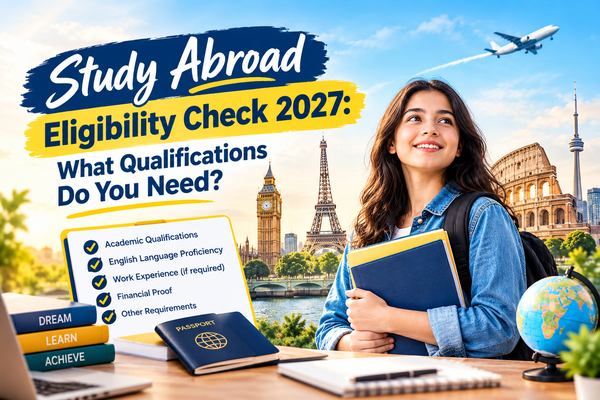
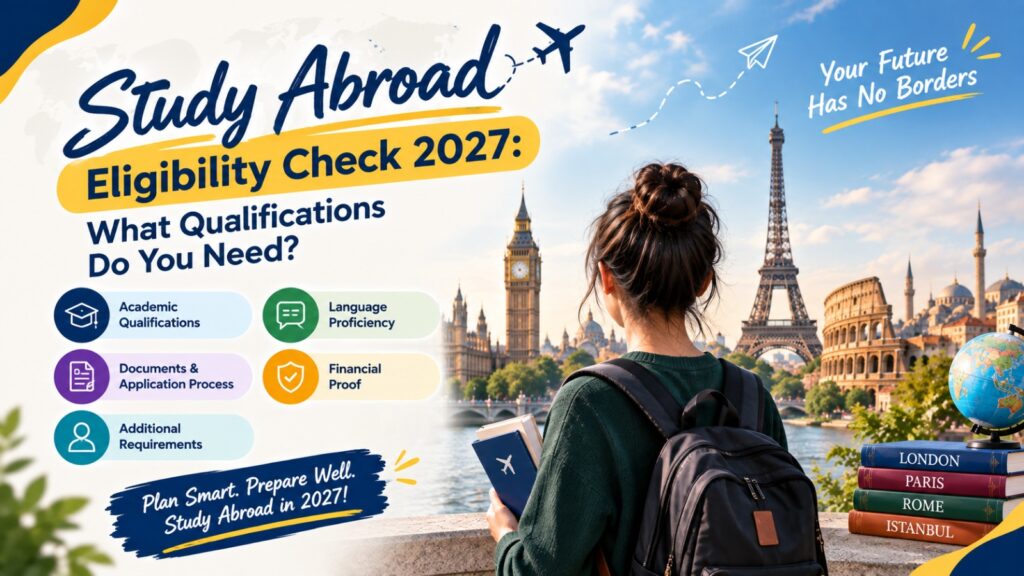
Planning to study abroad in 2027? One of the first questions students usually ask is: “Am I eligible to study abroad?”
The answer depends on several factors, including your academic qualifications, grades, English language proficiency, chosen course, university requirements, financial documents, and visa requirements. Every country and university can have different admission criteria, so understanding the basic eligibility requirements before applying can save you time, money, and unnecessary complications.
Whether you are planning for a Bachelor’s, Master’s, or PhD program, checking your eligibility early can help you choose the right university and prepare your documents properly.
In this guide, we explain the major eligibility requirements that students should consider for the 2027 study abroad intake.
1. Academic Qualification
Your previous education is one of the most important factors in determining your eligibility for studying abroad.
The required qualification depends on the level of study you want to pursue.
For Bachelor’s Programs
Students applying for a Bachelor’s degree generally need to have completed their Higher Secondary School Certificate (HSSC), Intermediate, A-Levels, or an equivalent qualification.
For Pakistani students, this may include:
- F.A
- F.Sc
- I.Com
- ICS
- A-Levels
- Other recognized equivalent qualifications
The required academic background may also depend on the selected subject. For example, an engineering program may require a science or mathematics background, while a business program may accept students from several academic backgrounds.
For Master’s Programs
Students applying for a Master’s degree normally need a recognized Bachelor’s degree in a relevant or accepted field.
Some universities may require a specific degree background, while others may accept students from related disciplines.
For example, a student applying for a Master’s in Computer Science may need a Bachelor’s degree in Computer Science, IT, Software Engineering, or another related field, depending on the university.
For PhD Programs
PhD applicants generally need a relevant Master’s degree or equivalent postgraduate qualification. Universities may also require a research proposal, academic references, previous research experience, or evidence of academic publications depending on the program.
2. Academic Grades and Percentage
Having the required qualification does not always mean automatic admission. Universities may also look at your grades, percentage, CGPA, or academic performance.
The minimum academic requirement can vary significantly between:
- Countries
- Universities
- Courses
- Degree levels
- Scholarship programs
For example, one university may accept students with a certain percentage, while another university may require a higher academic score for the same or a similar program.
Therefore, students should always check the specific academic requirements of their selected university before submitting an application.
Don’t worry if your grades are not very high
A lower percentage does not necessarily mean that you cannot study abroad. There may be universities, courses, foundation programs, pathway programs, or alternative study options with different entry requirements.
The important thing is to find an option that matches your academic profile.
3. English Language Proficiency
For many international study destinations, students need to demonstrate their ability to study and communicate in English.
Common English language tests include:
- IELTS
- PTE Academic
- TOEFL
- Duolingo English Test
However, the accepted tests and minimum scores vary from university to university.
Some universities may also offer exemptions or accept alternative proof of English proficiency in certain circumstances. Therefore, students should check the language requirements of their selected institution rather than assuming that one test or score applies everywhere.
Is IELTS mandatory?
Not always.
Some universities may accept students without IELTS if they meet specific conditions, such as having previous education taught in English or providing another accepted form of English-language proof.
However, this depends entirely on the university, country, and program.
4. Course-Specific Requirements
Your eligibility also depends on the course or subject you want to study.
Different programs can have different academic prerequisites.
For example:
- Engineering programs may require Mathematics and relevant science subjects.
- Medical programs may require Biology, Chemistry, or other specific subjects.
- Computer Science programs may require Mathematics or a relevant technical background.
- Business programs may accept students from a wider range of academic backgrounds.
- Art and design programs may require a portfolio.
- Some Master’s programs may require a Bachelor’s degree in a specific or related subject.
This is why students should not check only the university’s general admission requirements. They should also check the specific entry requirements of the selected course.
5. Study Gap and Previous Education
A study gap does not automatically make a student ineligible to study abroad.
However, universities or visa authorities may want to understand what you did during the gap period.
A study gap can sometimes be explained through:
- Employment
- Business
- Professional training
- Internships
- Family responsibilities
- Further education
- Relevant certifications
- Other genuine activities
The important thing is to provide a clear and truthful explanation and supporting documents where appropriate.
Students with study gaps should choose a course that makes sense in relation to their previous education and professional background.
6. Financial Eligibility
Admission eligibility and visa eligibility are not always the same.
Even after receiving an admission offer, students may need to demonstrate that they have sufficient funds to support their studies and living expenses.
Depending on the destination and visa rules, students may need to provide evidence related to:
- Tuition fees
- Accommodation
- Living expenses
- Travel expenses
- Bank statements
- Financial sponsorship
- Scholarships or other financial support
The exact financial requirements vary by country and can change over time.
For the 2027 intake, students should check the latest official financial requirements before preparing their visa application.
7. Passport and Important Documents
A valid passport is an essential document for international study.
Students should also prepare their academic and supporting documents well in advance.
Depending on the university and destination, commonly required documents may include:
- Valid passport
- Academic certificates
- Transcripts or mark sheets
- English language test result
- CV/Resume
- Statement of Purpose (SOP)
- Letters of Recommendation (where required)
- Experience letters (if applicable)
- Bank or financial documents
- Passport-size photographs
- Portfolio (for selected courses)
Some documents may need translation, attestation, verification, or specific formatting.
8. Statement of Purpose and Motivation
For many Bachelor’s, Master’s, and postgraduate applications, universities may ask students to provide a Statement of Purpose (SOP) or personal statement.
An SOP normally explains:
- Your academic background
- Why you selected the course
- Why you selected the university
- Your career goals
- Your relevant experience or interests
- How the program fits your future plans
A strong SOP should be genuine and consistent with your academic and professional background. Students should avoid using generic information that does not explain their individual study plans.
9. Work Experience Requirements
Work experience is not mandatory for every study abroad program.
Some courses accept fresh graduates, while others may prefer or require previous professional experience.
For example, certain Master’s programs, MBA programs, professional courses, or specialized programs may have specific experience requirements.
If work experience is required, students may need documents such as:
- Experience letters
- Employment certificates
- Salary slips
- Professional references
Always check the exact requirement of your selected course.
10. Age Requirements
Age requirements can vary depending on the country, institution, course, and visa regulations.
For most higher education programs, there is not necessarily a single universal maximum age for international students. However, an applicant’s overall academic history, study plan, previous education, and circumstances may be considered during the admission or visa process.
Instead of assuming that your age makes you eligible or ineligible, it is better to evaluate your complete academic and professional profile.
11. Visa Eligibility
Getting admission to a university is only one part of studying abroad.
After receiving an offer or acceptance, students generally need to meet the requirements for the relevant student visa or study permit.
Visa requirements may include:
- Valid passport
- University admission or acceptance letter
- Proof of funds
- Academic documents
- English language evidence where applicable
- Health or medical requirements where applicable
- Insurance requirements where applicable
- Genuine study-purpose requirements
- Visa application forms and supporting documents
Visa requirements are country-specific and can change, so students should always use the latest official immigration information when preparing their application.
12. Scholarship Eligibility
If you are planning to study abroad with a scholarship, you should check scholarship eligibility separately from university admission requirements.
Scholarships may consider:
- Academic performance
- English proficiency
- Financial circumstances
- Nationality
- Course or field of study
- Research experience
- Leadership or extracurricular activities
- Work experience
Some scholarships cover tuition fees only, while others may provide additional financial support such as accommodation, living expenses, insurance, or travel assistance.
Therefore, students should carefully check whether a scholarship is fully funded, partially funded, or tuition-based before applying.
Study Abroad Eligibility Checklist for 2027
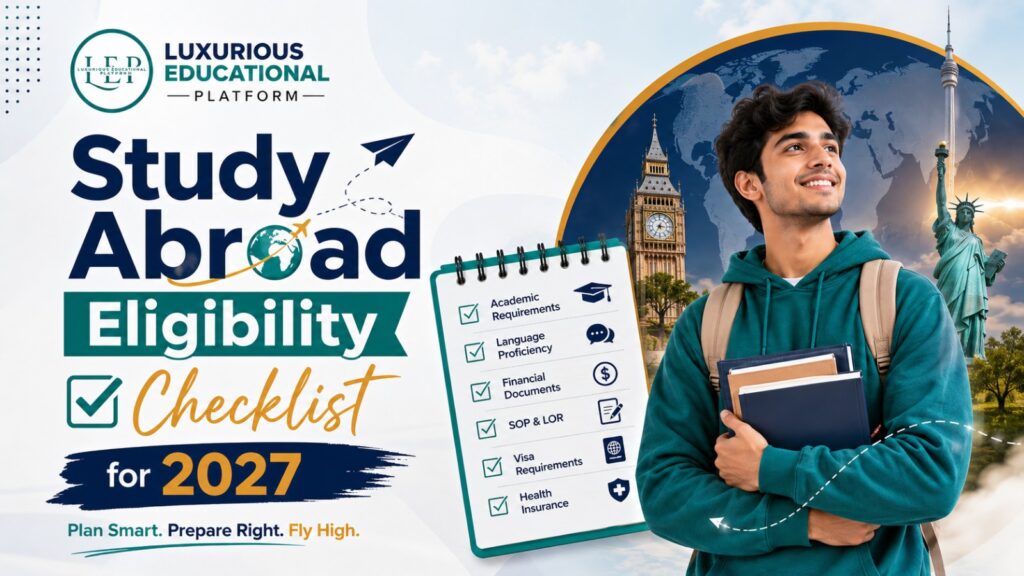
Before applying, ask yourself the following questions:
Academic
- Have I completed the required previous qualification?
- Does my academic background match my selected course?
- Do I meet the minimum percentage or CGPA requirement?
English Language
- Do I need IELTS, PTE, TOEFL, or another English test?
- Does my selected university accept my test?
- Do I meet the required score?
Documents
- Is my passport valid?
- Do I have my certificates and transcripts?
- Do I need document attestation or translation?
- Do I have the required SOP, CV, recommendation letters, or experience documents?
Financial
- Can I demonstrate the required financial resources?
- Have I considered tuition fees and living expenses?
- Am I eligible for any scholarships or financial support?
Visa
- Do I meet the current student visa requirements?
- Can I provide the required financial and academic evidence?
- Is my study plan consistent with my previous education and future career goals?
Why Should You Check Your Eligibility Early for the 2027 Intake?
Start Your Eligibility Check Early
Starting your eligibility check early is one of the most important steps when planning to study abroad for the 2027 intake. Many students wait until they have selected a university or the application deadline is approaching before checking whether they actually meet the admission requirements. This can create unnecessary stress and may leave very little time to correct problems.
An early eligibility check gives you enough time to review your academic qualifications, English language requirements, documents, financial situation, passport validity, and other conditions that may apply to your chosen university, course, and destination. It also allows you to identify any gaps in your profile and take the necessary steps before submitting your application.
For example, during an early eligibility check, you may discover that:
- You need an English language test: Some universities and courses require proof of English proficiency through IELTS, TOEFL, PTE, or another accepted test. Checking this requirement early gives you enough time to prepare, take the test, and receive your result before the application deadline.
- Your chosen course requires a specific academic background: Some programs may require students to have studied particular subjects or hold a relevant qualification. For example, certain engineering, medical, business, IT, or science programs may have specific academic requirements. Checking this in advance can help you avoid applying for a course that does not match your qualifications.
- You need additional documents: Universities may ask for academic certificates, transcripts, recommendation letters, personal statements, CVs, English test results, passport copies, or other supporting documents. Some documents can take time to obtain, verify, attest, or translate, so preparing them early can make the process easier.
- Your passport needs renewal: A valid passport is an important part of international study and visa processing. If your passport is expired or close to expiry, checking this early gives you enough time to renew it without delaying your application.
- You may qualify for another university or course: Your first choice may not always be the most suitable option based on your academic profile, budget, English score, or career goals. An early eligibility assessment can help you identify other universities and courses where your qualifications may be a better match.
- You need to improve your English test score: If your current English score does not meet the requirement of your selected university, you may need additional preparation and another test attempt. Starting early gives you more time to improve your score rather than rushing before the deadline.
- You may be eligible for scholarship opportunities: Some scholarships have separate eligibility requirements, earlier deadlines, or additional documents. By checking your eligibility early, you can identify potential scholarship opportunities and prepare the required documents on time.
- You need additional time to prepare financial documents: Depending on the destination and visa requirements, students may need to provide financial evidence or proof of funds. Preparing these documents at the last moment can be stressful, so it is better to understand the requirements well in advance.
- Your documents may require attestation or verification: In some cases, educational documents may need verification, attestation, translation, or other formal procedures. These processes can take additional time, especially when several documents are involved.
- You may need to improve your overall academic profile: If your academic record, English proficiency, or other qualification does not fully meet your preferred option, an early assessment gives you time to explore possible alternatives and improve your profile where possible.
Why Early Eligibility Checking Matters
An early eligibility check is not only about finding out whether you qualify. It helps you understand what you need to do before you apply. Once you know the requirements, you can create a realistic preparation plan and complete each step without unnecessary pressure.
For example, if you discover that your preferred university requires an English test, you can schedule your preparation and test well before the admission deadline. If you find that your chosen course requires a particular academic background, you can research alternative courses or universities that accept your existing qualifications.
Similarly, if you discover that some of your documents are missing, you have enough time to arrange them. If your passport needs renewal, you can complete the renewal process before starting important application or visa procedures.
Avoid Last-Minute Problems
One of the biggest advantages of checking eligibility early is that it helps reduce last-minute problems. Students may sometimes spend weeks researching universities only to discover later that they do not meet an important requirement. This can result in wasted time, missed deadlines, and unnecessary stress.
By checking your eligibility at the beginning, you can identify potential issues while there is still enough time to solve them. You can also compare different options instead of making a rushed decision simply because an application deadline is approaching.
Make a Clear Study Abroad Plan
Once you understand your eligibility, you can create a more organized plan for your 2027 intake. You can decide which universities and courses to target, which documents you need, whether an English test is required, what scholarship opportunities may be available, and how much preparation time you need.
It is also useful to create a personal checklist and keep track of important deadlines. This can include university application deadlines, scholarship deadlines, English test dates, document preparation, financial planning, and visa-related preparation.
Get Professional Guidance When Needed
Study abroad eligibility can vary depending on the country, university, course, academic level, and individual student profile. Therefore, students should always check the latest requirements from the relevant university and official authorities before applying.
If you are unsure whether your qualifications match your preferred destination or course, professional counselling can also help you understand your available options. A proper eligibility assessment can help you choose realistic universities and courses based on your education, budget, career goals, and preferred destination.
Start Early and Stay Prepared
Early planning gives you something very valuable: time. Time to improve your English score, arrange documents, explore universities, search for scholarships, prepare your finances, renew your passport, and make changes if your first option is not suitable.
Instead of waiting until the application deadline is close, start checking your eligibility as early as possible. A well-planned application gives you more time to identify problems, explore alternatives, and prepare the required documents properly.
The earlier you check your eligibility, the more time you have to prepare, improve your profile, explore your options, and submit a stronger and more organized application for the 2027 intake.e.
Let Luxurious Educational Platform Help You Check Your Eligibility

Get Professional Guidance for Your Study Abroad Plans
Choosing the right country, university, and course can sometimes be confusing, especially when every institution and destination has different admission requirements, academic criteria, English language requirements, document requirements, tuition fees, and application deadlines.
With so many study abroad options available, students may find it difficult to understand which option is suitable for their academic background, budget, career goals, and future plans. Making the right decision at the beginning can help you avoid unnecessary delays and focus on opportunities that are more relevant to your profile.
Luxurious Educational Platform (LEP) provides study abroad guidance for students who want to explore international education opportunities and plan their future studies abroad.
Our team can help you understand your academic profile, explore suitable countries and universities, identify relevant courses, review basic eligibility requirements, and understand the documents and steps generally involved in the application process.
How Luxurious Educational Platform Can Help
Every student has a different educational background and different study abroad goals. That is why we believe that study abroad planning should be based on the individual student’s profile rather than following the same approach for everyone.
Our guidance can help you:
- Understand your academic qualifications and study options.
- Explore suitable countries and universities according to your profile.
- Identify courses that are relevant to your previous education and career goals.
- Review basic admission and eligibility requirements.
- Understand English language requirements and available test options.
- Prepare and organize the documents required for your application.
- Explore scholarship and financial support opportunities where applicable.
- Understand important application steps and deadlines.
- Compare different study options based on your budget and preferences.
- Get guidance about the general application and admission process.
- Prepare for the next stages of your study abroad journey in a more organized way.
Whether you are planning for a Bachelor’s, Master’s, or another international study program, our team can help you understand the available options and the next steps based on your education, budget, career goals, and preferred destination.
Start Your 2027 Study Abroad Journey Early
If you are planning to study abroad for the 2027 intake, now is a good time to start reviewing your eligibility and preparing your plans. Waiting until the last moment can make the process more stressful because you may need additional time for English language tests, document preparation, university applications, financial planning, or other requirements.
Starting early gives you more time to research your options, identify potential problems, improve your profile where needed, prepare important documents, and make informed decisions about your destination and course.
Instead of choosing a university simply because it is popular, it is important to understand whether its course, academic requirements, tuition fees, location, and other conditions are suitable for your individual situation.
Let Us Help You Plan Your Next Step
Your study abroad journey starts with understanding where you currently stand and what options are available to you.
At Luxurious Educational Platform (LEP), we are available to guide you through your study abroad journey and help you handle your case from initial eligibility assessment and study option selection to the application process.
Our goal is to make the process easier to understand by helping you identify suitable options and prepare for each stage in an organized way. We can also help you understand what documents and information may be required so that you can move forward with greater clarity.
If you are still unsure about which country, university, or course may be suitable for you, you can start by discussing your educational background and future goals with our team.
Take the First Step Toward Your 2027 Intake
Don’t wait until the last moment to check your eligibility.
Start planning your 2027 intake early, review your qualifications, prepare your documents, explore suitable universities and courses, and identify the study options that match your profile.
The earlier you start, the more time you have to understand your options and prepare properly for the application process.
Luxurious Educational Platform is available to guide you through your study abroad journey and help you handle your case from eligibility assessment to the application process.
Your qualifications are the starting point — the right planning, preparation, and guidance can help you turn your study abroad goal into a realistic and well-organized plan.