


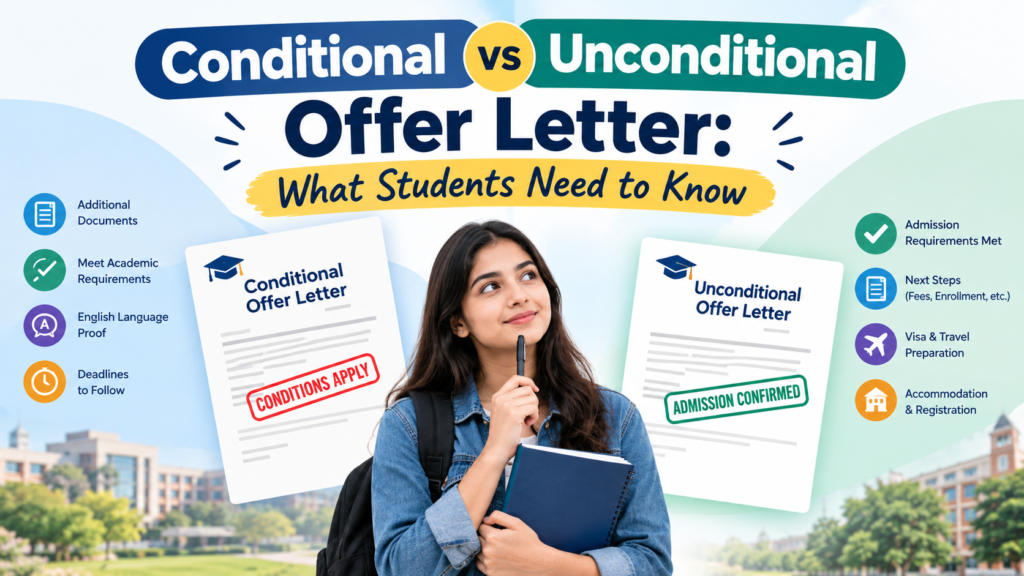
Receiving an offer letter from a university is an exciting milestone for any student planning to study abroad. However, not all offer letters mean the same thing. Universities generally issue conditional or unconditional offer letters, and understanding the difference between the two is extremely important before you move forward with your admission, visa application, or travel plans.
Many students receive an offer letter and immediately assume that their admission is completely finalized. In reality, a conditional offer may require you to complete certain requirements before your admission becomes unconditional.
In this guide, we will explain the difference between conditional and unconditional offer letters, what each type means, what students need to do after receiving one, and how these offers can affect the next steps in your study-abroad journey.
What Is a University Offer Letter?
A university offer letter is an official communication from an educational institution confirming that a student has been offered a place on a particular course or program.
The offer letter usually contains important information such as:
- Student’s name and application details
- Name of the university or institution
- Degree or program name
- Course start date
- Duration of the program
- Tuition fee information
- Conditions of admission, if applicable
- Documents or requirements that must be completed
- Deadline for accepting the offer
- Instructions for the next admission steps
Depending on whether all admission requirements have been fulfilled, the university may issue either a conditional offer letter or an unconditional offer letter.
What Is a Conditional Offer Letter?
A conditional offer letter means that the university has offered you admission, but you still need to meet one or more specified requirements before your admission becomes fully confirmed.
In simple words, the university is saying:
“We are willing to admit you, provided that you complete the requirements mentioned in your offer letter.”
The conditions can vary depending on the university, country, program, and individual student’s academic background.
Common Conditions in an Offer Letter
A university may issue a conditional offer if you still need to provide or complete certain requirements, such as:
- Final academic transcripts
- Degree or graduation certificate
- English language test results
- IELTS, TOEFL, PTE, or another accepted English test
- Minimum academic grades
- Attestation or verification of documents
- Passport copy
- Financial documents
- Payment of a required deposit
- Completion of a foundation or preparatory course
- Additional academic documents
- Other university-specific requirements
For example, a student may apply for a master’s degree while completing their final semester. The university may issue a conditional offer stating that the student must submit their final degree certificate and meet the required academic criteria before enrollment is confirmed.
What Is an Unconditional Offer Letter?
An unconditional offer letter means that the university has confirmed that you have met the admission requirements specified for your application.
In general, there are no outstanding academic conditions that you need to fulfill before your admission can be confirmed.
An unconditional offer may indicate that the university has reviewed your submitted documents and determined that you satisfy the relevant admission requirements.
However, students should still carefully read the entire offer letter because an unconditional offer does not necessarily mean that every step of the overall study-abroad process is complete.
There may still be other steps such as:
- Accepting the university offer
- Paying tuition fees or a required deposit
- Completing enrollment procedures
- Providing additional administrative documents
- Meeting immigration or visa requirements
- Arranging accommodation
- Completing university registration
Therefore, students should not assume that receiving an unconditional offer automatically means they can travel immediately.
Conditional vs Unconditional Offer Letter: Key Difference
The main difference is whether the student still has outstanding admission requirements.
| Conditional Offer | Unconditional Offer |
|---|---|
| Admission is subject to specific conditions | Admission requirements have generally been satisfied |
| Student may need to submit additional documents | No outstanding academic conditions may remain |
| Student may need to meet a required grade | Required academic criteria have been met |
| English test may still be required | Required English evidence may already be accepted |
| Offer can become unconditional after requirements are met | Offer is generally confirmed subject to remaining administrative steps |
| Student must carefully track deadlines and conditions | Student can usually proceed with the next admission steps |
The exact meaning can vary between institutions, so students should always read the wording of their individual offer letter carefully.
Why Do Universities Issue Conditional Offers?
Conditional offers are common because students often apply to universities before they have completed every requirement.
For example, a student might still be:
- Completing their final semester
- Waiting for final examination results
- Waiting for an English language test
- Waiting for official academic documents
- Completing document verification
- Waiting for an official degree certificate
Instead of rejecting the application or asking the student to wait until every document is available, the university may issue a conditional offer.
This allows the student to understand that they have been considered suitable for the program, provided they fulfill the remaining requirements.
What Should Students Do After Receiving a Conditional Offer?
Receiving a conditional offer is only one step in the admission process. Students should carefully review every condition mentioned in the letter.
1. Read the Offer Letter Carefully
Do not focus only on the university name and course title. Look for a section that explains the conditions attached to your offer.
Make a list of every outstanding requirement.
2. Check the Deadline
Universities often provide deadlines for accepting the offer or submitting the required documents.
Missing a deadline could delay your admission or affect your place on the course.
3. Complete the Conditions
Submit the required documents or evidence as soon as possible.
For example, if your offer requires an English language test, you should arrange the test and submit the required result according to the university’s instructions.
4. Keep Copies of Everything
Keep copies of:
- Offer letter
- Academic documents
- English test results
- Passport
- Payment receipts
- Emails from the university
- Submitted application documents
Maintaining organized records can make the admission and visa process easier.
5. Confirm When the Conditions Are Satisfied
After submitting the required documents, check with the university whether your conditions have been successfully cleared.
Do not simply assume that submitting a document means the condition has been accepted.
Can a Conditional Offer Become Unconditional?
Yes. A conditional offer can generally become unconditional once the student fulfills all the conditions specified by the university.
For example:
Conditional Offer → Submit Final Degree → Meet English Requirement → University Verification → Unconditional Offer
The exact process depends on the institution.
Students should therefore communicate with the university’s admissions team if they are unsure whether a condition has been fulfilled.
What Should Students Do After Receiving an Unconditional Offer?

An unconditional offer is an important milestone, but there may still be several steps to complete.
Students should check:
- Whether they need to formally accept the offer.
- Whether a tuition fee deposit is required.
- The deadline for payment.
- Whether additional documents are required.
- Whether they need to complete an enrollment process.
- What documents are required for their student visa.
- Whether accommodation arrangements are needed.
- When and where they need to complete university registration.
The university’s instructions should always be followed because requirements vary between institutions and countries.
Does an Offer Letter Guarantee a Student Visa?
No. An offer letter and a student visa are separate parts of the international education process.
A university offer confirms an academic admission decision, while a visa application is assessed under the immigration rules of the destination country.
Depending on the country, visa authorities may consider factors such as:
- Valid admission documentation
- Financial evidence
- Passport and identity documents
- Academic background
- English language requirements where applicable
- Health or insurance requirements where applicable
- Immigration history
- Genuine study-related requirements
- Other country-specific criteria
Therefore, students should not assume that an unconditional offer automatically guarantees visa approval.
Conditional Offer vs Unconditional Offer: Which One Is Better?
These two types of offers should not simply be viewed as “better” or “worse.” They represent different stages of the admission process.
A conditional offer means that some requirements are still outstanding, while an unconditional offer generally means that the stated admission conditions have been satisfied.
For students, the most important thing is to understand what conditions remain, when they must be completed, and what happens after they are fulfilled.
Important Things Students Should Check in Their Offer Letter
Before accepting an offer, students should carefully review the following:
Course Details
Make sure the program name, level, duration, and intake are correct.
Tuition Fees
Check the total tuition fee and understand any deposit or payment requirements.
Conditions
Identify every condition attached to the offer.
Deadlines
Check deadlines for accepting the offer, submitting documents, and making payments.
Refund Policy
If you are required to pay a deposit, understand the university’s refund policy and circumstances under which fees may or may not be refundable.
English Language Requirements
Check whether an English language test is required and which tests are accepted.
Academic Requirements
Make sure you understand any minimum grade or qualification requirements.
Visa Documentation
Check what university documents you may need for the student visa process after completing the admission requirements.
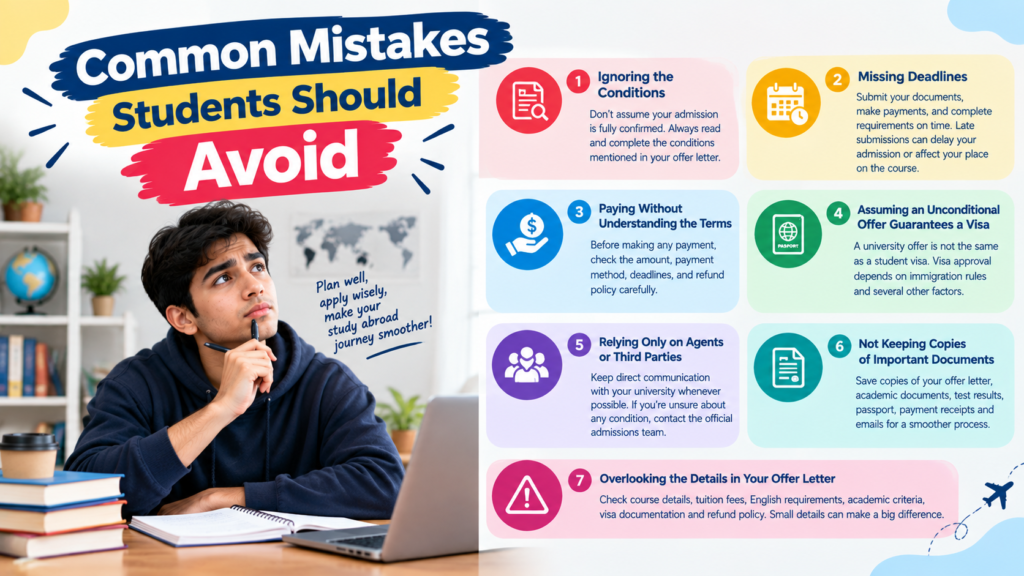
Common Mistakes Students Should Avoid
Ignoring the Conditions
One of the biggest mistakes is receiving a conditional offer and assuming the admission is already completely finalized.
Always identify and complete the outstanding requirements.
Missing Deadlines
Even a strong application can face delays if documents or payments are submitted after the required deadline.
Paying Without Understanding the Terms
Before making a tuition deposit or other payment, students should carefully review the payment instructions, deadlines, and applicable refund terms.
Assuming an Unconditional Offer Guarantees a Visa
An unconditional university offer does not automatically mean that immigration authorities will approve a student visa.
Relying Only on Agents or Third Parties
Students should keep direct communication with their university whenever possible. If there is uncertainty about a condition, contacting the university’s official admissions team can help clarify the situation.
Frequently Asked Questions
Is a conditional offer a confirmed admission?
A conditional offer is an offer of admission subject to specific requirements. The student generally needs to fulfill those conditions before the admission becomes unconditional.
Can I apply for a student visa with a conditional offer?
This depends on the country, university, and type of outstanding condition. Some institutions may require students to satisfy all relevant academic conditions before issuing the documents needed for a visa application. Students should check the specific requirements of their university and destination country.
How long does it take to change a conditional offer to unconditional?
There is no universal timeframe. It depends on the university, the type of condition, how quickly the student submits the required evidence, and how long the university takes to verify it.
What happens if I cannot meet a condition?
If you cannot meet a condition by the specified deadline, contact the university as soon as possible. The university may explain whether an extension, alternative evidence, or another option is available.
Is an unconditional offer the final step?
Not necessarily. You may still need to accept the offer, pay required fees, complete enrollment, obtain the necessary immigration documentation, and satisfy visa requirements.
Final Thoughts
Understanding the difference between a conditional and unconditional offer letter can help students make informed decisions and avoid unnecessary delays during the university admission process.
A conditional offer means that certain requirements are still outstanding, while an unconditional offer generally confirms that the specified admission conditions have been met. Regardless of which type of offer you receive, carefully reading the university’s instructions, meeting deadlines, submitting accurate documents, and maintaining communication with the institution are essential.
If you are planning to study abroad, treat your offer letter as an important document and review every section carefully. When something is unclear, contact the university’s official admissions office rather than relying on assumptions.
Your offer letter is an important step toward studying abroad—but understanding what it actually means is just as important as receiving it.
How Luxurious Educational Platform Can Help You

Understanding university admission requirements can sometimes be confusing, especially when you receive a conditional offer and are not sure what you need to do next. Luxurious Educational Platform (LEP) can help students understand their admission journey and prepare for the next steps with proper guidance.
Our team can assist students in understanding their conditional or unconditional offer letters, identifying outstanding requirements, and explaining the documents and steps that may be required before moving forward.
Offer Letter Guidance
If you have received an offer letter but are unsure whether it is conditional or unconditional, we can help you understand the information mentioned in the document and explain what the listed conditions mean.
Document Preparation
Students may need to provide different academic and personal documents during the admission process. LEP can guide students regarding the documents they may need to prepare and submit according to the requirements communicated by their university.
Admission Process Support
From understanding your offer letter to preparing for the next stage of your application, our team can provide step-by-step guidance throughout the admission process.
Guidance for Unconditional Offers
If you have received an unconditional offer, we can help you understand the next steps, such as offer acceptance, tuition fee requirements, university procedures, and preparation for the next stage of your study-abroad journey.
Support for Conditional Offers
If your offer is conditional, we can help you identify the outstanding requirements and understand what needs to be completed before your offer can progress to the next stage.
Study Abroad Guidance
Choosing a university and preparing to study abroad involves more than simply receiving an offer letter. Students may need to consider admission requirements, financial documentation, accommodation, visa-related requirements, and other important preparations.
Luxurious Educational Platform aims to make this process easier to understand by providing students with clear, practical, and personalized educational guidance.
Why Understanding Your Offer Letter Matters
Your offer letter contains important information about your university admission. Missing a condition, misunderstanding a deadline, or failing to submit a required document can potentially cause unnecessary delays.
With the right guidance, students can better understand their responsibilities and prepare each stage of the process carefully.
At Luxurious Educational Platform, our goal is to help students understand their options, prepare their documents, and navigate their study-abroad journey with greater clarity and confidence.
If you have received a conditional or unconditional offer letter and are unsure about your next step, our team can guide you through the process and help you understand what needs to be done next.