

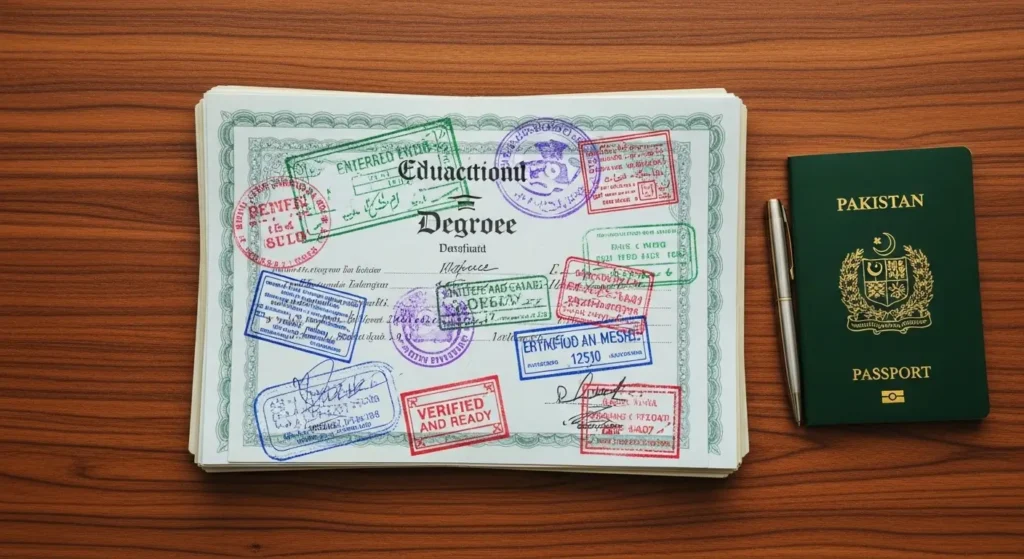
You have finally received your university acceptance letter. You have celebrated with your family, and you are ready to pack your bags. But wait—there is one massive, confusing hurdle left before you can even apply for your visa: document attestation in Pakistan.
For decades, the process of verifying educational certificates has been a source of sheer panic for Pakistani students. It involves navigating a maze of different government departments, paying various challan forms, standing in endless queues, and dealing with strict courier rules. If you make a single mistake—like going to MOFA before IBCC, or forgetting to get your matriculation certificate verified by your local board first—you will be sent home to start all over again.
As we discussed in our previous guide on why a Student Visa is Refused, submitting unverified or improperly attested documents is a guaranteed way to get your visa application rejected and potentially face a ban.
At Luxurious Educational Platform, we handle this bureaucratic maze every single day. We know the 2026 online portal updates, the courier shortcuts, and the exact sequence of stamps you need. To save you time, money, and a massive headache, we have created this foolproof, step-by-step guide to document attestation in Pakistan.
The Golden Rule: The Chain of Verification
Before we dive into the steps, you must understand the “Chain of Verification.” You cannot skip a step. The higher authorities will not stamp your document unless the lower authority has stamped it first.
The universal sequence for document attestation in Pakistan is:
Local Board/University $\rightarrow$ IBCC or HEC $\rightarrow$ MOFA $\rightarrow$ Destination Embassy.
Let’s break down exactly how to conquer each boss in this game.
Step 1: Local Board Verification (For Matric & F.Sc)
Before you can even approach the federal offices in Islamabad or provincial capitals, you must start at your roots.
If you are applying for an undergraduate Bachelor’s degree or an MBBS program abroad, your Matriculation (SSC) and Intermediate (HSSC) certificates must be verified by the specific BISE (Board of Intermediate and Secondary Education) from where you passed.
- How to do it: You must visit your local board (e.g., BISE Lahore, BISE Federal, BISE Karachi). You submit a fee, and they will stamp the back of your original certificates and put them in a sealed envelope.
- Crucial Tip 2026: Do not open the sealed envelope they give you! If the seal is broken, the next department will reject it instantly.
Step 2: IBCC Attestation (For School & College Certificates)
Once your local board has verified your Matric and F.Sc documents, they must be attested by the Inter Board Coordination Commission (IBCC). The IBCC verifies that your local board’s stamp is genuine.
- The Process: In 2026, IBCC has heavily digitized. You must create an account on their online portal, fill out the application, generate a challan, and pay the fee.
- Submission: You can book an appointment to go in person (which takes a full day of waiting), or you can use their official courier partners (like TCS or Leopard).
- What you get: A QR-coded sticker and stamp on the back of your original Matric and F.Sc certificates.

Step 3: HEC Attestation (For Bachelor’s & Master’s Degrees)
If you are applying for a Master’s or PhD abroad, the embassy does not care much about your Matric/F.Sc. They care about your Bachelor’s degree. This falls under the jurisdiction of the Higher Education Commission (HEC).
- The Process: You must upload scanned copies of all your educational documents (from Matric all the way to your Bachelor’s degree and transcripts) onto the HEC E-portal.
- The Waiting Game: HEC will digitally scrutinize your uploaded documents. This initial scrutiny can take anywhere from a few days to a few weeks. Do not wait until the last minute!
- Final Submission: Once approved online, you will be asked to either schedule an in-person appointment or send the original degree and transcript via TCS.
- The Result: HEC will affix a transparent, highly secure ticket/stamp to the back of your original degree and transcript.
Step 4: MOFA Attestation (The Final Boss)
The Ministry of Foreign Affairs (MOFA) is the bridge between Pakistan and the rest of the world. Foreign embassies in Pakistan do not recognize IBCC or HEC; they only recognize MOFA. MOFA’s job is simply to verify that the HEC and IBCC stamps on your documents are real.
- The Good News: MOFA does not require an online appointment for educational documents. It is a walk-in service, or you can use TCS/Gerry’s.
- The Bad News: If you go in person to the Islamabad headquarters or provincial camp offices (Lahore, Karachi, Quetta, Peshawar), the lines are legendary. You must arrive at 6:00 AM to get a token.
- The Smart Move: Unless you are flying tomorrow, use the courier service. It takes about a week, but it saves you from standing in the sun for eight hours.
Step 5: Embassy Legalization (Destination Specific)
You have your MOFA stamps. Are you done? Almost. Depending on where you are going, you might need “Embassy Legalization.”
- For the UK, USA, and Australia: Usually, MOFA attestation is enough. You upload the scanned, MOFA-attested documents to your visa portal.
- For China, UAE, Turkey, and Europe (Schengen): These countries often require you to take your MOFA-attested documents to their specific embassy in Islamabad to get their country’s stamp on the back. This proves to their home government that the Pakistani government has cleared you.
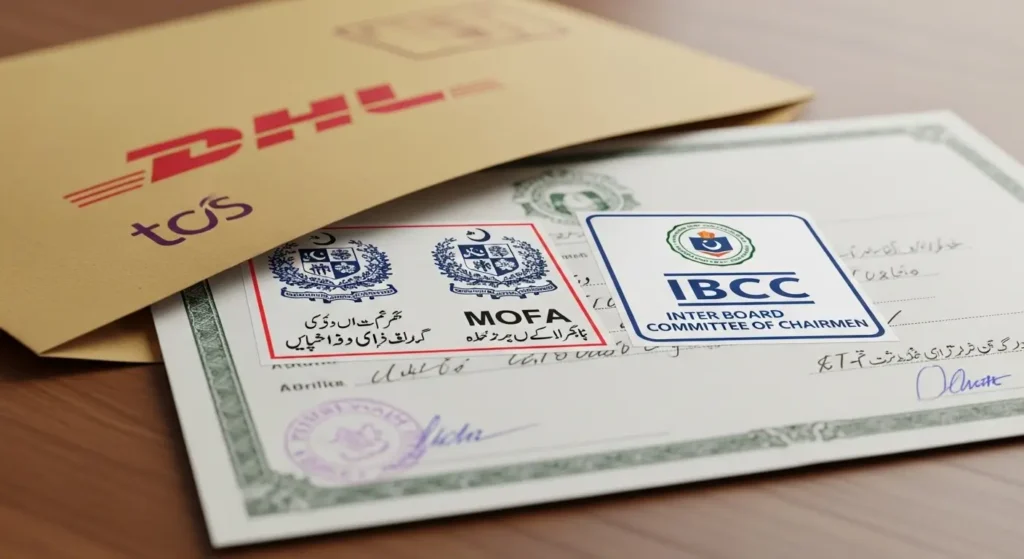
Why DIY is a Nightmare (And How We Help)
Reading this guide makes it sound simple, but the reality of document attestation in Pakistan is brutal. Name spelling mismatches between your passport and your degree, faded local board stamps, or server crashes on the HEC portal can delay your visa application by months. If you miss your university enrollment deadline because your documents are stuck in a government office, your admission will be canceled.
At Luxurious Educational Platform, we believe your time should be spent preparing for your IELTS or packing your bags—not standing in queues outside MOFA.
Our Premium Attestation Service: When you process your study abroad application with us, our dedicated compliance team handles the entire attestation headache. We audit your documents for spelling errors before submitting them, we manage the courier logistics, and we ensure every single stamp is perfectly aligned for embassy approval.
Don’t let red tape ruin your dreams. Let the experts handle your paperwork.