Introduction: A Complete Guide for Pakistani Students
Studying abroad is an important step for students who want to receive an international education, develop professional skills, and explore better academic and career opportunities. However, before applying to an international university, students must understand the admission requirements of their preferred country and institution.
Every country has its own education system, and admission requirements can vary depending on the university, degree level, selected course, and academic background of the applicant. Some universities accept Intermediate qualifications for undergraduate programmes, while others may require students to complete a foundation programme before beginning their bachelor’s degree.
Similarly, students applying for master’s programmes generally need a relevant bachelor’s degree that meets the university’s academic criteria.
For Pakistani students, understanding these requirements before applying can help prevent unnecessary delays, incomplete applications, and avoidable expenses.
In this guide, we will explain the general admission requirements for eight popular study destinations: the United Kingdom, Turkey, Northern Cyprus, the Republic of Cyprus, China, Georgia, Kyrgyzstan, and Iran.
We will also discuss academic qualifications, English-language requirements, supporting documents, the application process, and common mistakes students should avoid.
Important: The requirements explained in this article are general guidelines. Students should always confirm the latest requirements directly with their chosen university and the relevant official authorities.
1. Basic Admission Requirements for Pakistani Students
Before selecting a country, students should understand the basic documents commonly required for international university applications.
Although the exact checklist differs between institutions, the following documents may be required.
1.1 Academic Certificates and Transcripts
Academic documents are among the most important parts of a university application.
Depending on the programme, students may need to provide:
- Matriculation certificate and marksheet.
- Intermediate or HSSC certificate and marksheet.
- Bachelor’s degree and academic transcripts.
- Master’s degree and transcripts, where applicable.
- Other certificates required for a particular course.
Students should ensure that their academic documents are complete and that their names, dates of birth, and other personal details are consistent.
Some universities may request official translations, certified copies, or additional verification of academic qualifications.
1.2 Valid Passport
A valid passport is generally required when applying to international universities.
Students should check that their passport details match their academic documents. They should also ensure that the passport has sufficient validity for the intended application and travel process.
If a passport is not yet available, students should check the university’s application instructions to determine whether it is required at the initial application stage.
1.3 English-Language Proficiency
Many international universities offer programmes taught in English.
Depending on the university and course, students may need to demonstrate their English-language proficiency through an accepted test, such as IELTS Academic, or another approved method.
Some institutions may accept alternative English tests, conduct their own assessment, or offer a waiver under specific conditions.
However, students should not assume that every university accepts an MOI (Medium of Instruction) certificate instead of IELTS.
The accepted tests, minimum scores, and waiver conditions must be verified with the relevant university.
1.4 Statement of Purpose or Personal Statement
A Statement of Purpose (SOP) explains why a student wants to study a particular course and how the programme relates to their academic background and future goals.
Some universities require an SOP for admission, particularly for postgraduate programmes.
A strong SOP should explain:
- The student’s educational background.
- Why they selected the subject.
- Why they are interested in the university.
- How the course relates to their future goals.
- What they hope to achieve after completing their education.
Students should provide accurate information and avoid copying generic statements from other applications.
1.5 CV or Resume
Some universities request a CV, especially for postgraduate, research-based, or professional programmes.
A CV may include academic qualifications, relevant employment, internships, professional training, research experience, and relevant skills.
Students should keep their CV clear, accurate, and relevant to the programme.
1.6 Recommendation Letters
Recommendation letters may be required for selected bachelor’s, master’s, and doctoral programmes.
These letters can be provided by teachers, academic supervisors, or professional referees, depending on the university’s instructions.
Students should check the number of recommendations required and whether the university expects referees to submit them directly.
1.7 Financial Documents
Financial documents are often important during the visa process.
Depending on the destination and circumstances, students may need to provide evidence of sufficient funds, sponsorship documents, or other financial information.
However, financial evidence for a visa should not automatically be treated as a standard academic admission requirement. The university and immigration authority may have different requirements.
| Country | Undergraduate Admission | Master’s Admission | English Language Requirement | Study Gap | Main Documents |
|---|---|---|---|---|---|
| UK | Intermediate / equivalent qualification | Bachelor’s degree | IELTS or other university-accepted test; exemptions vary | Case-by-case | Academic transcripts, passport, English proof, personal statement |
| Turkey | Intermediate / equivalent qualification | Bachelor’s degree | IELTS, TOEFL, or another accepted test; requirements vary | University-dependent | Academic documents, passport, language proof, recommendation letters if required |
| Northern Cyprus | Intermediate / equivalent qualification | Bachelor’s degree | IELTS/TOEFL may be required; some universities offer alternatives | Case-by-case | Academic records, passport, application form, language proof if required |
| Republic of Cyprus | Intermediate / equivalent qualification | Bachelor’s degree | IELTS or another accepted test, depending on institution | University-dependent | Academic records, passport, English proof, supporting documents |
| China | Intermediate / equivalent qualification | Bachelor’s degree | English proof for English-taught programs; Chinese proficiency for some Chinese-taught programs | Depends on university and program | Academic records, passport, language proof, medical documents if required |
| Georgia | Intermediate / equivalent qualification | Bachelor’s degree | Requirements depend on the program; an interview or language assessment may be accepted | Case-by-case | Academic records, passport, application form, translated documents if required |
| Kyrgyzstan | Intermediate / equivalent qualification | Bachelor’s degree | Depends on the language of instruction and university policy | University-dependent | Academic records, passport, application form, other university-required documents |
| Iran | Intermediate / equivalent qualification | Bachelor’s degree | Persian or English proficiency, depending on the program | Depends on university and program | Academic records, passport, language proof, other required documents |
2. Admission Requirements for the United Kingdom (UK)
The United Kingdom is a popular destination for international students because it offers a wide range of undergraduate, postgraduate, and professional programmes.
However, admission requirements depend on the university, selected course, and the student’s previous academic qualifications.
Pakistani students should check whether their existing qualifications meet the requirements for direct entry or whether they need an alternative pathway.
2.1 Undergraduate Admission Requirements
Students applying for bachelor’s programmes generally need a completed secondary-school qualification accepted by the university.
For Pakistani applicants, this may involve an Intermediate or HSSC qualification, but direct entry is not guaranteed at every institution.
Depending on the university and course, students may need to complete a foundation programme before beginning their bachelor’s degree.
Admission decisions can depend on:
- Academic marks and grades.
- Relevant subjects studied previously.
- The university’s qualification-equivalency rules.
- English-language proficiency.
- Additional course-specific requirements.
For example, a student applying for a science-related degree may need to demonstrate that they have studied the required science subjects.
Students should check the exact entry criteria for their preferred programme rather than relying only on general information about studying in the UK.
2.2 Master’s Admission Requirements
Students applying for a master’s degree generally need a bachelor’s degree that meets the university’s academic requirements.
The university may consider the applicant’s grades, previous subject, academic progression, and the relevance of their qualification to the intended programme.
Some master’s programmes may also require:
- A Statement of Purpose.
- Academic or professional references.
- A CV.
- Relevant work experience.
- A research proposal.
- An interview or portfolio.
These requirements are not universal and depend on the selected programme.
Students should check the university’s official international admissions page to understand how Pakistani bachelor’s qualifications are evaluated.
2.3 English-Language Requirements
Many UK universities require evidence of English-language proficiency.
IELTS Academic and other accepted tests may be used, depending on the institution and course.
Some universities may accept alternative evidence or waive a test under specific conditions. However, students should obtain confirmation from the university before relying on an exemption.
An MOI certificate may be accepted by some institutions or for certain courses, but it is not universally accepted.
2.4 Documents Required for UK University Applications
Commonly requested documents may include:
- Passport.
- Academic certificates.
- Academic transcripts.
- English-language test results, if required.
- Personal statement.
- CV, where applicable.
- Recommendation letters, where required.
- Additional documents specified by the university.
Students should submit accurate documents and respond promptly if the university requests additional information.
2.5 Important Points for Pakistani Students
Before applying to a UK university, students should:
- Check whether their academic qualification is accepted.
- Confirm whether direct entry or a foundation programme is appropriate.
- Review the course’s minimum academic requirements.
- Confirm English-language requirements.
- Check tuition fees, deposits, and refund conditions.
- Review application deadlines.
- Check official UK Student visa requirements separately.
Receiving an admission offer does not automatically grant permission to travel to or study in the UK. Students must satisfy the applicable immigration requirements.
3. Admission Requirements for Turkey
Turkey offers a variety of undergraduate and postgraduate programmes through public and private universities.
Students can find programmes taught in Turkish and English, depending on the institution and subject.
However, admission requirements differ between universities. Applicants should therefore select specific courses before preparing their applications.
3.1 Undergraduate Admission Requirements
Students applying for bachelor’s programmes generally need a completed secondary-school qualification, such as Intermediate or HSSC, accepted by the university.
The university may evaluate:
- Academic marks.
- Previous subjects.
- Qualification equivalency.
- Language proficiency.
- Entrance examination results, where applicable.
- Other programme-specific criteria.
Some universities may require entrance examinations, aptitude tests, interviews, or additional assessments.
Other institutions may evaluate applicants primarily through their academic records and supporting documents.
Students should not assume that one examination or admission rule applies to every Turkish university.
3.2 Master’s Admission Requirements
Students applying for master’s programmes generally need a relevant bachelor’s degree.
Universities may assess the student’s academic performance and whether their previous degree is suitable for the intended subject.
Depending on the programme, applicants may need:
- Bachelor’s degree certificate.
- Academic transcripts.
- CV.
- Statement of Purpose.
- Recommendation letters.
- Research proposal.
- Interview or entrance-test results.
Research-based programmes may have additional requirements relating to research interests and academic preparation.
3.3 English and Turkish Language Requirements
The language requirement depends on the programme’s language of instruction.
English-taught programmes may require an accepted English-language test or an assessment conducted by the university.
Turkish-taught programmes may require evidence of Turkish-language proficiency.
Some institutions offer language-preparation programmes for students who do not meet the required language level.
Students should confirm the teaching language and accepted language evidence before applying.
3.4 Documents Required for Turkish Universities
Depending on the programme, applicants may need:
- Valid passport.
- Academic certificates and transcripts.
- Application form.
- Official translations, where required.
- English or Turkish language evidence.
- CV or personal statement for selected programmes.
- Additional documents requested by the university.
Students should follow the university’s current document checklist.
3.5 Important Points Before Applying
Before choosing a Turkish university, students should:
- Check the university’s admission requirements.
- Confirm whether an entrance examination is required.
- Compare tuition fees and other compulsory costs.
- Check scholarship eligibility and conditions.
- Review the university’s recognition and programme details.
- Confirm the campus location and teaching language.
- Verify the current student visa and residence procedures.
Students should also read their offer letter carefully and understand the payment schedule and refund policy before paying any deposit.
4. Admission Requirements for Northern Cyprus
Northern Cyprus has universities offering undergraduate and postgraduate programmes in different fields.
Students considering this destination should evaluate not only the admission requirements but also the institution’s recognition, programme quality, campus location, and total cost.
It is important to distinguish Northern Cyprus from the Republic of Cyprus because they are different locations and their relevant procedures may differ.
4.1 Undergraduate Admission Requirements
Applicants generally need a completed secondary-school qualification accepted by the selected university.
For Pakistani students, this may involve Intermediate or HSSC qualifications, subject to the university’s assessment.
Admission requirements can vary according to:
- Academic performance.
- Selected degree programme.
- Previous subjects.
- English-language proficiency.
- Additional requirements for professional or competitive courses.
Some students may be offered a preparatory route if they do not meet a particular entry or language condition.
4.2 Master’s Admission Requirements
Students applying for master’s programmes generally need a relevant bachelor’s degree.
The university may review the applicant’s academic background and determine whether their previous qualification is suitable for the intended course.
Some programmes may request a CV, Statement of Purpose, recommendation letters, portfolio, or interview.
Research-based programmes may require a research proposal and additional academic information.
4.3 Language Requirements
English-taught programmes may require an English-language test or an internal assessment.
Students who do not meet the required language level may be offered a preparatory course if the university provides this option.
Applicants should confirm the language requirement directly with the institution.
4.4 Documents Required
Commonly requested documents may include:
- Passport copy.
- Academic certificates.
- Academic transcripts.
- Application form.
- English-language evidence, if required.
- Official translations, where necessary.
- Other documents specified by the programme.
Students should submit complete and accurate documents according to the university’s instructions.
4.5 Important Considerations
Before applying, students should:
- Verify the university’s recognition and accreditation details.
- Confirm the exact campus and programme.
- Check whether the degree suits their intended career or further-study plans.
- Review tuition fees, accommodation expenses, and other costs.
- Understand deposit and refund conditions.
- Verify current travel, entry, and residence rules through relevant official authorities.
Students should avoid selecting a university based only on low tuition fees or promotional claims.
5. Admission Requirements for the Republic of Cyprus
The Republic of Cyprus offers undergraduate and postgraduate education through various institutions.
Admission requirements depend on the university, degree level, and selected course.
Students should confirm that they are researching the correct destination and the exact institution they intend to attend.
5.1 Undergraduate Admission Requirements
Applicants generally need a recognized secondary-school qualification that meets the university’s entry criteria.
Pakistani students may be required to submit their Intermediate or HSSC results and relevant academic documents.
The university may evaluate:
- Overall academic performance.
- Relevant subjects.
- Qualification equivalency.
- English-language proficiency.
- Additional course-specific conditions.
Some programmes may require interviews, entrance tests, portfolios, or other assessments.
5.2 Master’s Admission Requirements
Applicants generally need a relevant bachelor’s degree.
Universities may assess the student’s previous qualification, academic grades, and suitability for the selected programme.
Depending on the course, additional documents may include:
- CV.
- Statement of Purpose.
- Recommendation letters.
- Research proposal.
- Evidence of professional experience.
- Interview or portfolio.
Students should check the exact requirements of their selected department.
5.3 English-Language Requirements
English-language evidence may be required for programmes taught in English.
Accepted tests, minimum scores, and waiver policies vary between universities.
Students should confirm whether their previous education or another approved form of evidence can meet the language requirement.
They should not assume that an MOI certificate is accepted by every institution.
5.4 Common Application Documents
Students may be asked to provide:
- Passport.
- Academic certificates and transcripts.
- Application form.
- English-language evidence.
- Official translations.
- CV or personal statement, where required.
- Additional course-specific documents.
The university’s official checklist should always be followed.
5.5 Important Points to Consider
Before applying, students should:
- Verify the institution and programme’s recognition.
- Confirm academic entry requirements.
- Check the current tuition fees and application deadlines.
- Review deposit and refund conditions.
- Ask whether academic documents require translation or verification.
- Check official entry and residence requirements.
A careful review of these factors can help students make a more informed decision.
6. Admission Requirements for China
China offers a wide range of academic programmes for international students, including undergraduate and postgraduate degrees.
Programmes may be taught in Chinese or English, and admission requirements can differ according to the university, subject, degree level, and scholarship route.
6.1 Undergraduate Admission Requirements
Students applying for bachelor’s programmes generally need a completed secondary-school qualification accepted by the university.
Pakistani students should check whether their Intermediate or HSSC qualification meets the selected programme’s entry requirements.
Universities may consider:
- Academic grades.
- Previous subjects.
- Language proficiency.
- Entrance examinations, where applicable.
- Interviews or additional assessments.
- Other programme-specific conditions.
Some courses may require particular academic subjects or additional documents.
6.2 Master’s Admission Requirements
Students applying for master’s programmes generally need a bachelor’s degree in a relevant or accepted field.
The university may request academic transcripts and supporting documents to evaluate the applicant’s suitability.
Depending on the programme, applicants may need:
- Bachelor’s degree certificate.
- Academic transcripts.
- CV.
- Study plan or Statement of Purpose.
- Recommendation letters.
- Research proposal.
- Interview or other assessment.
Applicants for doctoral programmes normally need a relevant master’s degree and may have additional research-related requirements.
6.3 Language Requirements
Chinese-taught programmes may require Chinese-language proficiency or completion of a language-preparation programme.
English-taught programmes may require an accepted English-language test or another approved form of evidence.
Students should confirm the exact language requirements with the university.
6.4 Documents Required for Applications
Depending on the institution, students may need:
- Passport.
- Academic certificates and transcripts.
- Application form.
- Study plan or personal statement.
- Recommendation letters.
- Language test results, where required.
- Health examination documents or additional forms, if requested.
- Other programme-specific documents.
Scholarship applicants may have to meet additional requirements beyond the university’s normal admission criteria.
6.5 Important Points Before Applying
Students should:
- Check the university’s official international admission page.
- Confirm the current intake deadline.
- Review the teaching language and academic requirements.
- Verify whether documents require translation or authentication.
- Check scholarship eligibility separately.
- Review tuition fees and other compulsory costs.
- Confirm current student visa and entry requirements.
Students should use official university and scholarship information rather than relying only on social-media advertisements.
7. Admission Requirements for Georgia
Georgia offers various undergraduate and postgraduate programmes for international students.
Admission requirements depend on the institution and field of study. Certain professional fields, including medicine and dentistry, may involve additional academic, recognition, or regulatory requirements.
Students should carefully evaluate the suitability of their chosen degree before applying.
7.1 Undergraduate Admission Requirements
Applicants generally need a completed secondary-school qualification accepted by the university and any relevant authorities.
For Pakistani students, the university may review Intermediate or HSSC qualifications and determine whether they meet the entry criteria.
Additional requirements may include:
- Specific academic subjects.
- Minimum grades.
- Language proficiency.
- Interviews or assessments.
- Recognition or verification of previous education.
The exact requirements should be confirmed with the institution.
7.2 Master’s Admission Requirements
Applicants generally need a relevant bachelor’s degree.
Universities may review the previous degree, academic performance, and relationship between the applicant’s background and intended programme.
Some courses may require a CV, motivation letter, recommendation letters, an interview, or a research proposal.
Research-based programmes may have additional academic requirements.
7.3 Language Requirements
English-taught programmes may require an English-language test, interview, or internal assessment.
Students should confirm which forms of evidence are accepted and whether a waiver is available.
They should also understand the language used during practical training, placements, or clinical activities, where applicable.
7.4 Documents Required
Commonly requested documents may include:
- Passport.
- Academic certificates and transcripts.
- Application form.
- Official translations.
- Language test results, where required.
- CV or motivation letter for selected courses.
- Other programme-specific documents.
Some documents may require formal recognition or verification.
7.5 Important Points Before Applying
Before applying to a Georgian university, students should:
- Verify the institution’s recognition and programme details.
- Check professional licensing implications for regulated fields.
- Confirm whether documents require translation or legalization.
- Review tuition fees and living expenses.
- Check the university’s current admission deadlines.
- Verify the applicable entry and residence rules.
These steps are particularly important for students planning to enter a regulated profession after graduation.
8. Admission Requirements for Kyrgyzstan
Kyrgyzstan has institutions offering programmes in several academic and professional fields.
Students should research the exact university and course before applying because academic requirements and language arrangements can vary.
8.1 Undergraduate Admission Requirements
Applicants generally need a completed secondary-school qualification accepted by the university.
Pakistani students should confirm whether their Intermediate or HSSC qualification meets the institution’s academic criteria.
Universities may evaluate:
- Academic grades.
- Previous subjects.
- Language proficiency.
- Additional examinations or assessments.
- Programme-specific conditions.
Students transferring from another institution should ask whether previous credits can be assessed for recognition.
8.2 Master’s Admission Requirements
Applicants generally need a relevant bachelor’s degree.
The university may request academic transcripts and additional documents to assess the applicant’s suitability.
Depending on the programme, supporting documents may include:
- CV.
- Statement of Purpose.
- Recommendation letters.
- Research proposal.
- Interview results.
- Other academic evidence.
Students should follow the institution’s current instructions.
8.3 Language Requirements
The language of instruction can differ between programmes.
Some courses may use English, Russian, or another language.
Students should confirm the teaching language and whether they need to provide a language test, attend an interview, or complete a preparatory course.
Understanding the language of instruction is particularly important for programmes involving practical or clinical training.
8.4 Documents Required
Common documents may include:
- Passport copy.
- Academic certificates.
- Academic transcripts.
- Application form.
- Official translations, where required.
- Language evidence, if applicable.
- Other documents requested by the institution.
Additional documents may be required for professional programmes or transfer applications.
8.5 Important Points Before Applying
Students should:
- Verify the institution and programme’s recognition.
- Check professional licensing implications, particularly for medicine.
- Request written details of tuition and other compulsory fees.
- Review accommodation and living costs.
- Confirm document verification procedures.
- Check the official entry, registration, and residence process.
Students should carefully assess whether the qualification will support their intended career before making a financial commitment.
9. Admission Requirements for Iran
Admission requirements in Iran depend on the university, selected programme, academic level, and language of instruction.
International applicants should obtain current admission information directly from the institution and confirm any additional procedures with the relevant official authorities.
9.1 Undergraduate Admission Requirements
Students applying for undergraduate programmes generally need a recognized secondary-school qualification relevant to the intended course.
Pakistani applicants should ask the university whether their Intermediate or HSSC qualification meets the academic criteria.
Depending on the programme, additional requirements may include:
- Specific academic subjects.
- Minimum grades.
- Entrance examinations.
- Interviews.
- Language proficiency.
- Formal verification of academic documents.
Requirements should be confirmed before submitting the application.
9.2 Master’s Admission Requirements
Applicants generally need a relevant bachelor’s degree and academic transcripts.
The university may evaluate the student’s previous field of study, grades, and suitability for the intended programme.
Some programmes may request:
- CV.
- Statement of Purpose.
- Recommendation letters.
- Research proposal.
- Interview.
- Evidence of language proficiency.
Doctoral programmes may have additional research and academic requirements.
9.3 Language Requirements
Persian-taught programmes may require Persian-language proficiency or completion of a language-preparation course.
English-taught programmes may have separate requirements.
Students should confirm the teaching language and accepted language evidence with the university before applying.
9.4 Documents Required
Depending on the institution, applicants may need:
- Passport.
- Academic certificates and transcripts.
- Application form.
- Official translations.
- CV or Statement of Purpose.
- Recommendation letters.
- Research proposal or other course-specific documents.
Additional verification or approval may be required for certain applicants or programmes.
9.5 Important Points Before Applying
Students should:
- Verify the institution and programme’s recognition.
- Check whether the qualification suits their future study or career goals.
- Confirm the language of instruction.
- Ask about document translation and authentication.
- Review tuition fees and payment arrangements.
- Verify current entry and student-status procedures through official sources.
Students should avoid relying on unofficial online claims when making decisions about admission or travel.
10. How to Choose the Right Country and University
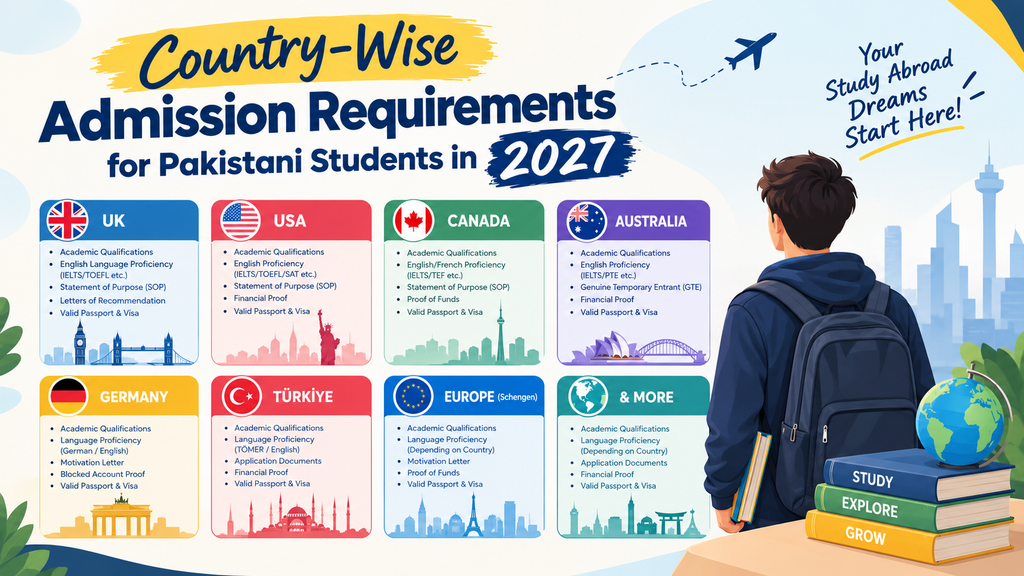
Choosing a study destination is an important decision. Students should consider more than a country’s popularity or the advertised tuition fee.
The right option depends on academic eligibility, financial resources, career plans, language ability, and personal circumstances.
10.1 Check Academic Eligibility
Before selecting a university, compare your existing qualification and grades with the entry requirements of the intended course.
If the university’s website does not clearly explain how Pakistani qualifications are assessed, contact the admissions office for clarification.
This is especially important when applying for direct undergraduate entry or a specialized postgraduate programme.
10.2 Compare Total Study Costs
Tuition fees are only one part of the overall study abroad budget.
Students should also consider:
- Application fees.
- Tuition deposits.
- Accommodation.
- Food and daily expenses.
- Transport.
- Health insurance, where required.
- Books and study materials.
- Travel expenses.
- Visa-related costs.
- Emergency savings.
The total cost varies according to the destination, city, university, and student’s lifestyle.
Students should create a realistic budget before accepting an offer.
10.3 Check University Recognition
Students should verify the university and programme’s recognition and consider whether the qualification will support their future plans.
This is particularly important for regulated professions, such as medicine and dentistry, where graduation alone may not be sufficient for professional registration in another country.
10.4 Understand the Teaching Language
Students should confirm the language used for lectures, examinations, practical training, and placements.
They should also understand the English-language or other language requirements for admission.
If a university offers a language-preparation course, applicants should check its duration, cost, and conditions.
10.5 Review Deadlines
University application deadlines differ between institutions and intakes.
Scholarship deadlines may also be different from general admission deadlines.
Students should allow enough time to obtain academic documents, arrange translations, complete language tests, and respond to university requests.
Applying early can help students manage the process more effectively, although it does not guarantee admission.
11. Step-by-Step Study Abroad Application Process
Following a clear process can help students organize their applications and reduce avoidable mistakes.
Step 1: Define Your Academic Goals
Decide which subject you want to study, what degree level you need, and how the programme relates to your future career.
Consider your previous education, grades, budget, and language proficiency.
Step 2: Choose Suitable Destinations
Research countries that offer programmes relevant to your interests and academic background.
Compare admission criteria, teaching languages, tuition fees, living costs, and recognition.
Step 3: Shortlist Universities
Select specific universities and courses rather than applying without a clear plan.
Read the official programme pages and note the entry requirements and deadlines.
Step 4: Confirm Your Eligibility
Compare your academic qualifications with the university’s requirements.
If any information is unclear, contact the admissions office before paying a non-refundable application fee.
Step 5: Prepare Your Documents
Collect your passport, academic certificates, transcripts, and other required documents.
Arrange official translations or verification if requested.
Prepare a personal statement, CV, recommendation letters, or other supporting documents where necessary.
Step 6: Submit Your Application
Use the university’s official application portal or another process confirmed by the institution.
Complete all fields accurately and check the application before submitting it.
Keep copies of your documents, application confirmation, and payment receipts.
Step 7: Monitor Your Application
Check your email and applicant portal regularly.
Respond to requests for missing documents, interviews, or additional information within the specified deadline.
Step 8: Review Your Admission Offer
If you receive an offer, check the programme name, campus, tuition fees, deposit, refund policy, conditions, and acceptance deadline.
Ask the university for clarification if any condition is unclear.
Step 9: Prepare for the Next Stage
After admission, review the official visa, financial evidence, insurance, accommodation, and travel requirements that apply to your destination.
Do not assume that the academic admission process automatically completes the immigration process.
12. Common Admission Mistakes Pakistani Students Should Avoid
Many application problems can be reduced by checking requirements carefully and preparing documents in advance.
The following mistakes are worth avoiding.
12.1 Applying Without Checking Eligibility
Students should not assume that every university accepts the same academic qualifications.
Always check whether your previous education meets the specific entry requirements of your intended course.
12.2 Assuming IELTS Is Always Required or Always Waived
English-language requirements vary between institutions and programmes.
Some universities may accept alternative tests or provide waivers under specific conditions, while others may require a particular test.
Confirm the rule directly with the university.
12.3 Submitting Incomplete Documents
Missing certificates, transcripts, translations, or other required documents can delay an application.
Use the official checklist to make sure all required documents are ready.
12.4 Ignoring Deadlines
Students should allow enough time to prepare their applications.
Waiting until the last minute can create problems if documents require translation, verification, or correction.
12.5 Paying Fees Without Verification
Before making payments, verify the university, application process, official offer, payment details, and refund conditions.
Keep written records of all transactions.
12.6 Choosing a University Based Only on Price
A low advertised tuition fee does not necessarily mean that a university is the best choice.
Students should also consider recognition, course quality, total expenses, language, and future career plans.
12.7 Confusing Admission With Visa Approval
An admission offer and a student visa are separate matters.
Universities decide admission, while the relevant authorities decide visa applications under their applicable rules.
Students should review each process independently.
13. How Luxurious Educational Platform (LEP) Can Help

Choosing the right university can feel confusing when students are comparing different countries, admission criteria, tuition fees, and language requirements.
Luxurious Educational Platform (LEP) can guide students as they explore study destinations and prepare for the application process.
The appropriate options depend on each student’s academic qualifications, grades, preferred subject, budget, language proficiency, and future goals.
LEP can help students understand university requirements, compare potential destinations, organize application documents, and identify the next steps in their study abroad planning.
Students should provide accurate academic information and ask questions whenever a requirement is unclear.
Please remember: Admission decisions remain with universities, and visa decisions remain with the relevant authorities. No consultant can responsibly guarantee admission or visa approval.
Planning to Study Abroad in 2027?
Not sure which country or university is suitable for your academic profile?
Contact Luxurious Educational Platform (LEP) to discuss your qualifications, budget, preferred course, and study abroad goals.
Our team can help you explore suitable options and understand the steps involved in preparing an application.
14. Final Checklist Before Applying
Before submitting your application, review the following questions:
- Have I selected a specific country, university, and course?
- Have I checked the entry requirements for Pakistani qualifications?
- Do I meet the academic and subject requirements?
- Have I confirmed the language of instruction?
- Do I understand the English-language requirements?
- Are my passport, certificates, and transcripts ready?
- Have I checked whether translations or document verification are required?
- Have I reviewed the application deadline?
- Do I understand the tuition fees and deposit conditions?
- Have I checked the university’s recognition and programme details?
- Have I reviewed the separate visa and financial requirements?
- Have I saved copies of all submitted documents and official communications?
Taking time to answer these questions can help you prepare a more organized application.
Conclusion
Studying abroad can be a valuable opportunity for Pakistani students, but choosing the right destination requires careful research and preparation.
The United Kingdom, Turkey, Northern Cyprus, the Republic of Cyprus, China, Georgia, Kyrgyzstan, and Iran each have different universities, programmes, and admission procedures.
Before applying, students should confirm their academic eligibility, prepare the required documents, understand the language requirements, compare total costs, and verify the recognition of their chosen institution.
Most importantly, students should rely on current official information rather than assumptions or unverified promises.
With careful planning and the right guidance, students can make better-informed decisions about their international education.
Start planning your study abroad journey with Luxurious Educational Platform (LEP) and explore the options that match your academic background, budget, and future goals.