

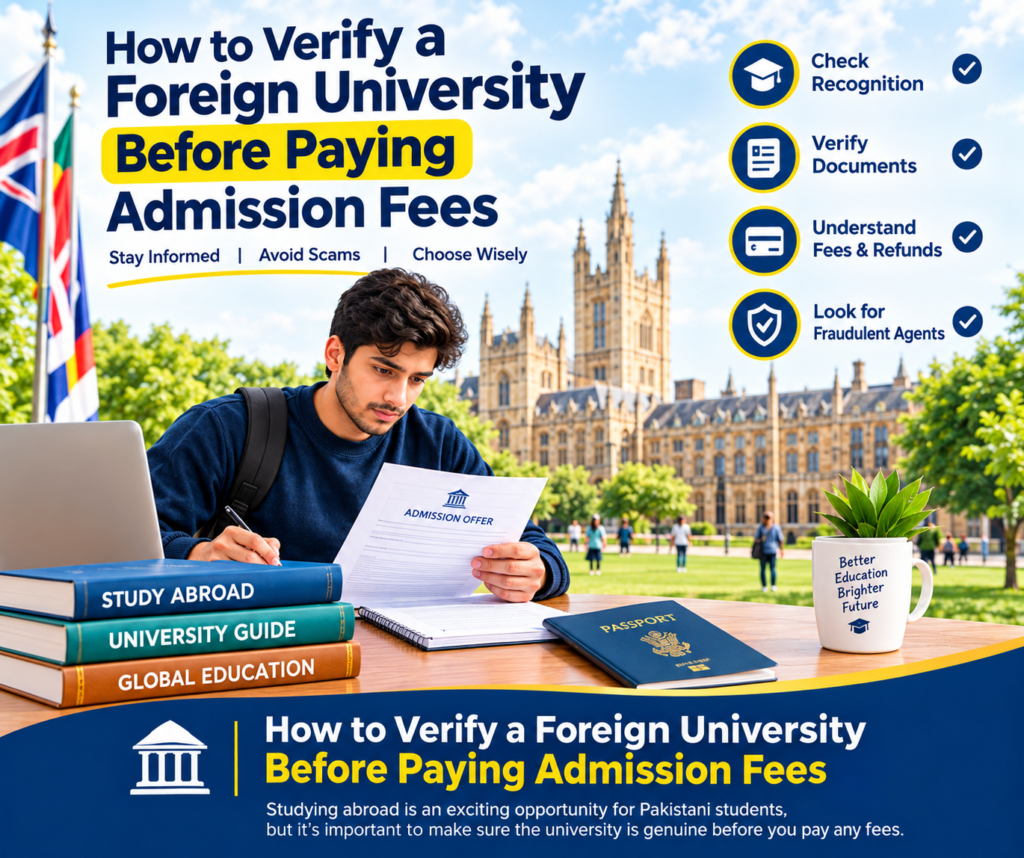
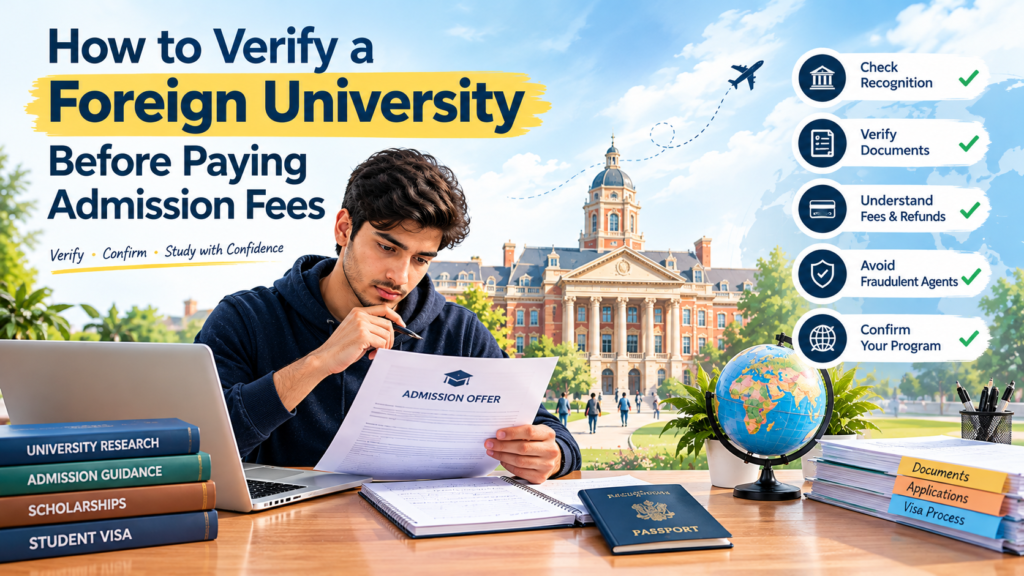
Studying abroad is an exciting opportunity for Pakistani students who want to receive an international education, gain new experiences, and build a successful career. Every year, students explore universities in countries such as Turkey, China, the United Kingdom, Italy, Iran, Georgia, and Cyprus to find suitable academic programs and affordable study options.
However, choosing a foreign university requires more than comparing tuition fees or looking at attractive advertisements. Students must also confirm that the institution is genuine, officially recognised, and suitable for their educational and professional goals. Before paying any admission fee, tuition deposit, or registration charge, it is important to verify the university and understand its admission process.
Unfortunately, some students lose money because they trust unverified education agents, misleading social media advertisements, or promises of guaranteed admission and visas. In other cases, students receive admission offers without properly checking whether their chosen degree meets their future career requirements.
The good news is that you can reduce these risks by following a few practical steps. In this guide, we will explain how Pakistani students can verify a foreign university before paying admission fees and make more informed decisions about their study abroad journey.
1. Check the University’s Official Website
The first step is to visit the university’s official website. Review its background, campus locations, available degree programs, admission requirements, tuition fees, and contact information.
A genuine institution should provide clear information about its academic programs and application procedures. You should also look for an official university email address, physical campus address, admissions department contact details, and information about its academic facilities.
In addition, check whether the university publishes an official fee structure and explains how international students can apply. If the information is incomplete or difficult to verify, contact the admissions department for clarification.
Be careful if an agent provides only a social media page, an unfamiliar website, or a payment link without explaining the university’s official application process. Although a professional-looking website can be helpful, it does not prove that an institution is genuine or recognised.
Practical tip: Do not rely exclusively on links provided by an agent. Search for the university independently and confirm that you are visiting its authentic website before sharing personal documents or making payments.
2. Verify University Recognition and Accreditation
One of the most important steps is to confirm that the university is legally recognised in its home country.
Different countries have different education systems and regulatory authorities. Therefore, you should check the institution through the appropriate official government education department or higher education regulator.
For example, students considering universities in Turkey should consult the relevant official Turkish higher education sources. Those planning to study in the United Kingdom should use the appropriate UK government resources to check the institution and the status of their intended course.
It is also important to understand the difference between university recognition and program accreditation. An institution may be legally recognised, but a specific degree program can have additional accreditation or professional licensing requirements.
This distinction is particularly important for students interested in medicine, dentistry, pharmacy, engineering, nursing, and other regulated professions. A degree that allows you to study abroad does not automatically guarantee that you can practise that profession in Pakistan or another country after graduation.
For medical education, Pakistani students should review the current requirements of the Pakistan Medical and Dental Council (PMDC). Students in other regulated fields should consult the relevant professional regulator.
Always confirm recognition requirements before making a financial commitment, especially if you plan to return to Pakistan and work in a regulated profession.
3. Confirm That Your Chosen Degree Program Is Available
Verifying the university alone is not enough. You must also confirm that your intended degree program is genuinely offered at the campus where you plan to study.
Some students select a university based on its reputation or affordable fees but later discover that their preferred program is unavailable for the intended intake. Others find that the course is taught at a different campus or has additional admission requirements.
Before applying, check the following details:
- The exact name of the degree program.
- The duration of the course.
- The campus where classes will take place.
- The language of instruction.
- The academic qualifications and minimum marks required.
- The application deadline and available intake.
- Any entrance examinations or English-language requirements.
- Additional accreditation or professional recognition requirements, where applicable.
You should also review the course curriculum to understand what subjects you will study and whether the program matches your career plans.
For example, a student interested in Pharmacy should confirm the exact qualification being awarded, the program’s recognition status, and the requirements for professional practice in the intended country.
Request written confirmation from the university’s admissions department if any important detail is unclear.
4. Verify the Admission Offer Letter
An admission or offer letter is an important part of the application process. However, receiving a letter does not automatically prove that the university or the offer is genuine.
Carefully review the document and check whether your personal information, intended degree, campus, intake, and other relevant details are correct. The letter may also include an application reference number, student identification number, or instructions for completing the next steps.
Look for inconsistencies such as misspelled university names, unusual email addresses, incorrect campus information, or unclear payment instructions.
If you receive an offer letter through an education consultant, contact the university directly using the contact details published on its official website. Ask the admissions team to confirm that your application and offer are genuine.
You should also clarify whether the offer is conditional or unconditional. A conditional offer may require you to submit additional documents, meet academic requirements, or provide proof of English-language proficiency before final admission is confirmed.
Remember: Never assume that a PDF document is genuine simply because it contains a university logo or an official-looking signature. Independent confirmation is a much safer approach.
5. Understand Tuition Fees and Payment Methods
Before transferring money, request an official fee structure from the university. It should explain the tuition fee, application or registration charges, initial deposit, and any other applicable costs.
You should also calculate your overall study budget rather than focusing only on the first payment. Depending on your destination, you may need to pay for accommodation, food, transportation, health insurance, visa processing, travel, and other living expenses.
Ask the university the following questions before making a payment:
- What is the exact amount required at this stage?
- Is the payment an application fee, tuition deposit, or full tuition payment?
- What is included in the fee?
- Are there additional registration or administrative charges?
- Is the deposit refundable if your visa is refused?
- What happens if you decide not to enrol?
- Will you receive an official receipt or payment confirmation?
Refund policies differ between institutions, so obtain the relevant policy in writing before paying.
Whenever possible, use a payment method and bank account that the university has confirmed through its official channels. Keep your invoice, transaction reference, receipt, and related correspondence for future reference.
Be cautious if someone asks you to transfer money to a personal account without a clear explanation, refuses to provide an official receipt, or pressures you to pay immediately to secure an offer.
A transparent payment process should allow you to understand exactly who is receiving your money and what the payment covers.
6. Verify the Education Consultant or Admission Agent
Many Pakistani students use education consultants to understand foreign admission procedures, compare universities, and prepare applications. A reliable consultant can make the process easier; however, students should also verify the consultant’s identity and the services being offered.
Start by checking the consultancy’s official website, business contact details, office information, and available student guidance services. Ask which university or authorised admission channel will process your application.
If a consultant claims to be an official representative of a particular university, request evidence of that relationship and confirm the claim directly with the university when possible.
You should also ask for a clear explanation of the consultancy’s service charges, if applicable. Make sure you understand which services are included, what additional costs may arise, and whether the consultant will provide written confirmation of the agreed services.
A professional consultant should explain the process honestly, answer reasonable questions, and allow you enough time to make an informed decision.
Avoid relying on verbal promises alone. Keep written records of important discussions, fee agreements, and application-related commitments.
7. Research the University’s Reputation and Student Experience
Official recognition is essential, but you should also investigate the university’s academic environment and student support services.
Research its teaching facilities, library resources, laboratories where relevant, accommodation options, international student support, and career development services. You can also explore whether the university offers academic advising, orientation programs, and assistance with student registration.
Online reviews may provide useful insights into the experiences of current students and graduates. However, reviews should not be your only source of information because some may be outdated, misleading, or based on individual experiences.
Where possible, speak with current students or alumni who have studied at the institution. Ask them about the quality of teaching, campus facilities, administrative support, and actual living expenses.
You should also consider the university’s location. A lower tuition fee may not necessarily mean a more affordable education if accommodation and transportation costs are significantly higher.
By comparing academic quality, overall expenses, and student support, you can make a decision that better suits your budget and long-term goals.
8. Check Scholarship Offers and Special Discounts
Scholarships and tuition discounts can make international education more affordable. However, students should verify scholarship offers carefully before paying an admission deposit.
Check whether the scholarship is offered directly by the university, a government organisation, or another recognised provider. Review the eligibility requirements, application deadline, award amount, and conditions for maintaining the scholarship.
It is also important to understand whether the scholarship covers full tuition fees or only provides a partial discount. Some awards may exclude accommodation, insurance, travel, and other living expenses.
Be cautious if someone promises a guaranteed scholarship in exchange for an unexplained advance payment. Ask for official written details and verify the offer with the scholarship provider.
A genuine scholarship opportunity should have clear terms and conditions. Never make a financial decision based solely on a verbal promise of a discount.
9. Be Careful of Guaranteed Admission and Visa Promises
One of the most important warning signs is a promise of guaranteed admission, guaranteed employment, or guaranteed visa approval in exchange for an upfront payment.
Universities make admission decisions according to their academic requirements and application procedures. Similarly, visa decisions are made by the relevant immigration authorities. An education consultant cannot honestly guarantee that every applicant will receive admission or a visa.
Be careful with claims such as “100% visa success,” “admission without any requirements,” or “pay today and your visa is confirmed” when no reliable documentation is provided.
A professional consultant should assess your academic profile, explain the available options, help you understand the documentation requirements, and guide you through the application process.
Students should also be honest in their applications. Providing false information, altered documents, or misleading financial evidence can result in serious consequences.
If an offer sounds unusually attractive or someone refuses to answer basic questions, pause the process and verify the information before making any payment.
10. Understand Visa Requirements Before Finalising Your Decision
Although university admission and visa approval are separate processes, both should be considered before choosing a study destination.
After receiving an offer, students may need to provide academic documents, proof of financial resources, health insurance, accommodation details, or other information depending on the destination and visa category.
Review the official immigration guidance for your intended country and make sure you understand the requirements that apply to your situation.
You should also check whether your intended course, institution, and study arrangement meet the relevant student visa conditions. Admission to a university does not automatically mean that you qualify for a visa.
If you are unsure about a particular requirement, consult the relevant immigration authority or seek appropriate professional guidance before proceeding.
Planning ahead can help you avoid unnecessary delays and reduce the risk of making decisions based on incorrect or outdated information.
11. Keep Copies of All Important Documents
Once you begin your application, maintain an organised record of your documents and communications.
Keep copies of your application form, admission offer, fee invoices, payment receipts, passport-related submissions, university emails, consultancy agreements, and refund policy.
Save important messages and confirm major decisions in writing. This can be useful if you need to clarify a payment, correct an error, or follow up on your application.
Never share sensitive personal documents through suspicious links or unverified accounts. Before submitting your passport, academic certificates, or financial documents, confirm that the recipient is legitimate and that the information is required for your application.
Good record-keeping can help you track the process and provide evidence if a dispute arises.
12. How Luxurious Educational Platform (LEP) Can Help You

Choosing a foreign university can be challenging, particularly when you are comparing countries, admission requirements, tuition fees, degree recognition, and visa procedures. For many Pakistani students, understanding where to begin is often the most difficult part of the journey.
Luxurious Educational Platform (LEP) provides study abroad consultancy and guidance for students who want to explore international education opportunities and make informed decisions about their future.
Our guidance can help students understand the admission process and evaluate available options according to their academic background, budget, and educational goals.
How LEP Supports Students
University and country selection: We help students explore suitable study destinations and university options according to their qualifications, interests, and financial plans.
Admission and application guidance: Students can receive guidance about entry requirements, application procedures, available intakes, and the documents needed for their chosen programs.
Documentation support: We help students understand the documents required for their applications and prepare their paperwork more carefully.
Fee and admission guidance: Students can learn which fee details, payment instructions, deposit conditions, and refund policies they should confirm before making a financial commitment.
Student visa guidance: We help students understand the relevant visa application process and documentation requirements for their intended destination.
Our goal is to help students approach the study abroad process with better preparation and a clearer understanding of the decisions they need to make. Students should still confirm university recognition, official payment instructions, and visa requirements through the relevant institutions and authorities.
Ready to start your study abroad journey?
If you are planning to study abroad but are unsure which university or country is right for you, Luxurious Educational Platform (LEP) can help you understand your available options and the next steps in your application process.
Get in touch with LEP for study destination selection, admission guidance, documentation support, and student visa guidance. Start planning early, ask the right questions, and make informed decisions before paying your university admission fees.
13. Final Checklist Before Paying Admission Fees
Before making a payment, review the following checklist carefully. If any important detail remains unclear, pause the payment until you receive satisfactory confirmation.
- I have checked the university’s official website and contact information.
- I have verified the institution through the appropriate official authority.
- I have confirmed that my chosen degree program is available at the intended campus.
- I have checked the course duration, language of instruction, and entry requirements.
- I have verified my admission offer directly with the university.
- I have received an official fee structure and payment instructions.
- I understand the deposit, cancellation, and refund policies.
- I have checked professional recognition requirements where applicable.
- I have verified any scholarship or tuition discount being offered.
- I understand the student visa requirements for my intended destination.
- I have confirmed the identity and services of my education consultant.
- I have saved copies of important documents, invoices, and payment receipts.
- I have not relied on guaranteed admission or visa promises.
Completing this checklist will not eliminate every possible risk, but it can help you identify warning signs and ask important questions before committing your money.
Frequently Asked Questions (FAQs)
1. How can I check whether a foreign university is genuine?
Visit the university’s official website, review its admission information, and confirm its recognition through the appropriate government education authority or higher education regulator. You can also contact the admissions department directly to verify your application and offer letter.
2. Should I pay an admission fee before receiving an offer letter?
The process varies between universities. Some institutions charge an application fee before reviewing an application, while others require a deposit after issuing an offer. Always confirm the payment requirement through the university’s official website or admissions department before transferring money.
3. How do I know whether a foreign degree will be recognised in Pakistan?
Recognition depends on the institution, qualification, program, and applicable rules. Check the relevant Pakistani authority before enrolling. For medical and dental qualifications, review current PMDC requirements. Other regulated professions may have their own recognition or licensing rules.
4. Is a university admission letter enough to prove that my admission is genuine?
No. An offer letter should be independently verified. Contact the university through its officially published contact details and ask the admissions department to confirm the letter and your application status.
5. Can an education consultant guarantee my student visa?
No consultant can guarantee a visa decision made by an immigration authority. A consultant may provide application guidance and help you understand documentation requirements, but the final decision rests with the relevant authority.
6. What should I do if I suspect an admission scam?
Do not send additional money or sensitive documents until you have verified the situation. Contact the university directly, preserve messages and payment records, and consider contacting your bank or the relevant authorities if you believe you have been defrauded.
Conclusion
Verifying a foreign university before paying admission fees is an essential step for Pakistani students planning to study abroad. Careful research can help you avoid misleading offers, understand the actual cost of education, and choose a university that matches your academic and professional goals.
Always check university recognition, confirm your degree program, verify admission documents, understand payment and refund conditions, and review the relevant visa requirements. Take your time, ask questions, and rely on official information instead of making decisions under pressure.
With proper preparation and appropriate guidance from Luxurious Educational Platform (LEP), you can approach your international education plans with greater confidence. Start researching early, verify the details before paying, and take your next step towards a well-planned study abroad journey.